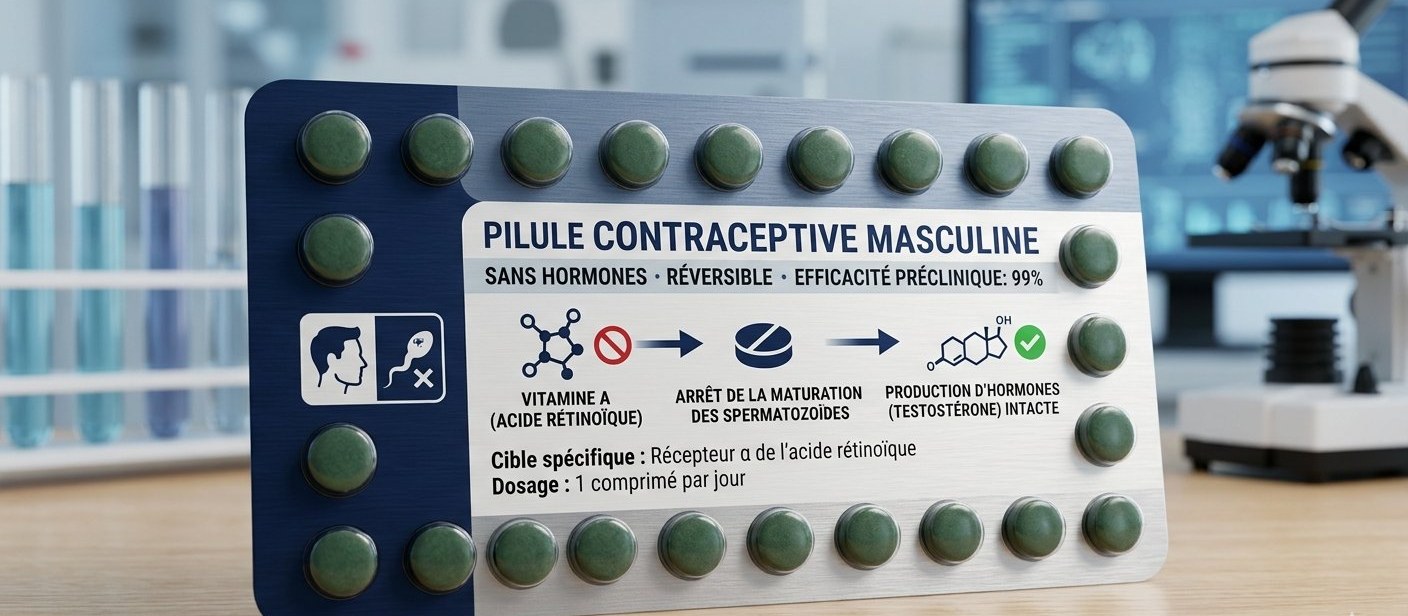
For 60 years, contraception has rested almost entirely on women. Men have only two options: condoms or vasectomy. In 2025, a molecule called YCT-529 has just passed its first human trial successfully — it blocks sperm production without touching hormones. It isn't a marketable pill yet, but it's a decisive step.
Why don't men have a contraceptive pill?
The female contraceptive pill has existed since 1960. In 65 years, options for men haven't moved an inch: condoms — with a typical-use failure rate of 13% — or vasectomy, a surgery with uncertain reversibility.
It's not for lack of trying. Dozens of molecules have been tested, including testosterone-based versions. Results: effective, but with notable side effects — acne, weight gain, mood swings, cardiovascular risks. A WHO-led international trial was even stopped early in 2011 because of these effects. The bar is high for a contraceptive: unlike drugs that treat a disease, here you give something to a healthy person. Tolerance for side effects is therefore very low.
The idea behind YCT-529 is different: don't touch hormones at all. Target the sperm production mechanism directly, through another pathway — vitamin A.
How vitamin A makes sperm cells
In the testes, sperm production — called spermatogenesis — depends on a precise chemical signal. That signal is retinoic acid, a derivative of vitamin A. Without it, the process stops. Researchers discovered that male mice in which the receptor that catches this signal (called RAR-α) is removed become completely sterile — but otherwise normal, healthy, with intact libido and normal hormone levels.
That's exactly what YCT-529 does: it blocks this RAR-α receptor in the testes, cutting the vitamin A signal needed for sperm production. No hormones altered, no testosterone touched. And reversibly — when the molecule is stopped, production resumes.
What the study tested — and what it found
In 2024, 16 male volunteers received increasing doses of YCT-529 (from 10 to 180 mg) in a phase 1a clinical trial — the first human step, whose only goal is to verify that the molecule is well tolerated and safe.
Results: no notable effect on testosterone, reproductive hormones, libido, or mood. The molecule was well absorbed by the body at all doses. No participant dropped out of the study.
→It doesn't assess contraceptive efficacy in humans
→It only lasts 15 days per dose — long-term effects remain unknown
→All participants had had a vasectomy — a specific context
What about mice and monkeys?
Before humans, YCT-529 had been tested in male mice (28 days of treatment) and in primates (108 days). In both cases, the molecule massively reduced sperm production — with a return to normal after stopping. In mice, contraceptive efficacy reached 99% during the first four weeks of treatment. No significant adverse effects were observed in these animal models.
These results justified moving to the human trial. And this human trial has just confirmed that the molecule is well tolerated. The next step, already underway, is to measure the actual impact on sperm in humans over 28 and 90 days.
🔍 Key takeaways
→YCT-529 blocks sperm production by targeting vitamin A — without touching hormones
→First successful human trial: well tolerated, no effect on testosterone, libido, or mood
→99% effective in mice — human efficacy data is coming in the next few months
→It's not an available pill yet — several years of trials remain before commercialization
✦ Bottom line
After 60 years of status quo, something is finally moving.
YCT-529 is not yet a male contraceptive pill. But it's the first non-hormonal molecule to have successfully passed a human safety trial — after decades of unsuccessful attempts with hormonal approaches. The next step will finally measure what we really want to know: does it work in the human body? Answers are on the way.
YCT-529 is a RAR-α (retinoic acid receptor alpha) antagonist that inhibits spermatogenesis without altering sex hormones. In a phase 1a clinical trial published in Communications Medicine, the molecule was well tolerated at doses up to 180 mg in 16 men. Testosterone, FSH, LH, and SHBG levels remained stable. A 28- and 90-day trial measuring actual impact on sperm is currently underway.
Why have hormonal approaches failed?
Hormonal methods work by inhibiting FSH and LH through negative feedback, thereby suppressing spermatogenesis. The problem: LH is also responsible for endogenous testosterone production. To compensate, exogenous testosterone must be administered — which cannot be taken orally (degraded by the liver) and must therefore be injected, applied as a gel, or via a patch. This complex regimen comes with documented side effects: erythrocytosis, acne, weight gain, cardiovascular risks, and mood changes.
The large NES/T trial (Nestorone + testosterone gel, phase 2b) showed 86% sperm suppression in 12 weeks in 222 men — real progress — but the non-oral route of administration remains a barrier to adoption. YCT-529 circumvents this problem by not involving hormones at all.
Mechanism of action: the retinoic acid – RAR-α axis
In the testes, spermatogenesis depends on the signal of all-trans retinoic acid (ATRA), an active metabolite of vitamin A (retinol). This signal is transmitted via the nuclear receptors RARα, RARβ, and RARγ. Genetic validation is robust: male mice with a knockout of the RARA1 gene are sterile but otherwise perfectly normal — hormone levels unchanged, sexual behavior intact, lifespan normal.
YCT-529 is a selective RAR-α antagonist. It binds to the receptor without activating it, preventing ATRA from transmitting its signal to germ cells. Result: differentiation of progenitor cells into mature sperm is blocked. Reversibility is ensured because spermatogonial stem cells — the origin of the entire process — are not affected and resume normal activity when treatment stops.
Phase 1a trial design and safety results
The trial (NCT06094283), conducted in Nottingham, UK, was randomized double-blind against placebo. Sixteen vasectomized men aged 32 to 59 received increasing single oral doses: 10, 30, 90, and 180 mg fasting, plus 30 mg under fed conditions. The choice of vasectomized subjects is methodologically justified for phase 1a: it allows safety evaluation without risk of accidental pregnancy, independently of the contraceptive effect that isn't yet measured.
At all doses, free testosterone, FSH, LH, and SHBG remained within reference intervals, with no significant variation from baseline. Sexual desire, mood, and erectile function scores assessed via a daily psychosexual diary showed no changes.
Dose (mg)
N active
T (ng/dL)
FSH / LH
Possibly-related TEAE
Placebo
4
Normal
Normal
0
10 mg
5
Normal
Normal
0
30 mg
6
Normal
Normal
0
90–180 mg
6
Normal
Normal
1 benign arrhythmia*
* Asymptomatic extrasystoles detected by Holter ECG, spontaneously resolved, deemed clinically insignificant by a cardiologist.
Pharmacokinetics: what this tells us about future dosing
YCT-529 reaches peak plasma concentration about 8 hours after intake (fasted). Its half-life is long: between 51 and 76 hours. This long half-life means the molecule accumulates with daily dosing, and the effective concentrations documented in animals are reached in humans at 90–180 mg as a single dose. The dosing regimen for the next phase will therefore be daily.
Bioavailability is slightly increased with a fatty meal (+36% AUC on average), but the confidence interval is wide — the current simple-capsule formulation will likely be optimized in later phases to reduce this variability.
🔍 Key points
→Non-hormonal mechanism: RAR-α inhibition → spermatogenesis blocked without altering T/FSH/LH
→Successful phase 1a: satisfactory tolerance, no hormonal or psychosexual effect at 10–180 mg
→Pharmacokinetics compatible with daily oral dosing (T1/2 51–76h, human AUC within effective animal range)
→Next step (NCT06542237): sperm count measurement after 28 and 90 days of repeated treatment
✦ What it changes in practice
The first real non-hormonal candidate for a male pill has just cleared its first human hurdle.
This is an important proof of concept: the RAR-α pathway is pharmacologically accessible in humans, without affecting hormones. But the crucial question — does it actually block sperm production in humans the way it does in mice? — still awaits its answer. The ongoing trial will provide it in the coming months. If results are positive, YCT-529 would become the first non-hormonal molecule to enter phase 2 of male contraceptive development.
Mannowetz et al. (2025) report results from a single-ascending-dose (SAD) phase 1a trial of YCT-529, a RAR-α antagonist developed as a non-hormonal male oral contraceptive. The trial (NCT06094283), conducted in 16 vasectomized men in Nottingham, UK, evaluates safety, tolerability, pharmacokinetics (PK), and pharmacodynamics (PD) at doses of 10–180 mg (fasted) and 30 mg (fed). Primary result: YCT-529 is well tolerated, with no notable safety signal. Human exposures reach levels associated with efficacy in animal models.
Molecular biology of the RAR-α target
All-trans retinoic acid (ATRA) regulates male germ-cell differentiation via the RARα/β/γ nuclear receptors. RAR-α is the principal mediator: RARA1 knockout mice are sterile but otherwise perfectly normal (no postnatal lethality, hormone profile intact, behaviour normal). Sterility results from meiotic arrest at the spermatocyte stage — spermatogonial stem cells (SSCs) are unaffected, which guarantees reversibility.
Previous pan-RAR antagonists (BMS-189453) had shown testicular toxicity in rats — likely via RAR-γ (expressed in Sertoli cells and immature germ cells). YCT-529 is developed with higher RAR-α selectivity, although full subtype-selectivity data are not published in this article.
Preclinically (Mannowetz et al., Commun Med, March 2025, doi:10.1038/s43856-025-00752-7): YCT-529 administered for 28 days in mice and 14 days in non-human primates (NHP) induces complete spermatogenesis inhibition with full recovery. No adverse events in 42-day (mouse) and 108-day (NHP) studies. IND-enabling studies in rats and dogs confirm a safety margin of 22 to 40× above the effective dose.
Detailed PK data and cross-species comparison
Single-dose PK parameters (fasted) show a median Tmax of 8h (10, 90, 180 mg) and 4h (30 mg) — high inter-subject variability (CV% 42–78% at doses ≤90 mg, 32% at 180 mg) likely of metabolic origin. Terminal half-life (T1/2) is 51–76h, guiding the choice of daily dosing in the next trial despite a half-life that would theoretically permit every 2–3 days dosing.
Species / condition
AUC (h·ng/mL)
Context
Mouse (single dose, effective)
7 713 (AUC0-∞)
Sterility at D28
Rat (D28, effective dose)
2 660 (AUC0-24)
IND-enabling study
Dog (D28, effective dose)
21 200 (AUC0-24)
IND-enabling study
NHP (D28, effective dose)
29 085 (AUC0-48)
Repeated administration
Human 90 mg fasted (single dose)
8 430 (AUC0-24)
Phase 1a
Human 180 mg fasted (single dose)
27 300 (AUC0-24)
Phase 1a
Cross-species comparative AUC data. The human AUC0-24 at 180 mg (single dose) falls within the effective range documented in dog and NHP. With accumulation from repeated dosing (T1/2 ~3 days), therapeutic exposures in humans appear achievable.
Dose proportionality and food effect analysis
Power-model proportionality analysis (PROC MIXED, SAS) shows that over the 30–180 mg range, AUC is dose-proportional (β ~1; AUC doubles when dose doubles), while Cmax is slightly supra-proportional (×2.26 per dose doubling). Over the full 10–180 mg range, proportionality is not confirmed — 10 mg exposure is sub-proportional, possibly due to saturable absorption at low concentration.
The food-effect study (30 mg, high-fat breakfast vs. fasted, N=8) shows increased bioavailability (Frel Cmax +60%, AUC0-t +37%, AUCinf +34%) with Tmax shifted to 10h vs. 4h. However, CIs are very wide (high inter-subject CV% variability), and the authors conclude there is no clear food effect — the simple-capsule formulation without release-modulating excipients likely explains this variability. An optimized formulation (sodium salt, solubilizing excipients) will likely be developed for later phases.
Cardiac safety: concentration-QTc analysis
Cardiac safety analysis is conducted by intensive Holter ECG according to ICH E14 guidelines. The concentration-response analysis (ΔΔQTcF vs. plasma [YCT-529], linear mixed-effects model) shows that the upper bound of the 90% CI remains below 10 ms (FDA regulatory threshold of concern) at all geometric-mean Cmax levels studied. At 180 mg (highest Cmax), estimated ΔΔQTcF = −6.12 ms (90% CI: −13.12; 0.89 ms). Time-point analysis confirms these results.
Un événement unique a été classé comme possiblement lié : arythmie asymptomatique de courte durée détectée par Holter chez un sujet du Cohorte 2 (qui avait reçu 90 mg puis 180 mg). Les événements — extrasystoles ventriculaires fréquentes, plusieurs couplets, un triplet lent, plusieurs couplets atriaux — sont apparus partiellement avant la dose de 180 mg (la dose de 90 mg étant washoutée selon les données PK), et partiellement 220 min après. Le sujet a été évalué par cardiogramme et échocardiogramme : aucune cardiopathie identifiée, résolution spontanée sans intervention. La causalité ne peut être exclue mais le tableau clinique est rassurant.
🔬 Limitations & perspectives
→Absence de mesure spermatique : la phase 1a ne mesure pas la numération — critère d'efficacité central. Le choix de sujets vasectomisés, justifié pour la sécurité, implique que les données PD de spermatogenèse humaine sont entièrement différées à la phase 1b/2a
→Dose unique seulement : les expositions en steady-state (dosage répété) seront substantiellement supérieures du fait de la longue T1/2 — profil de sécurité en dosage répété non encore établi chez l'humain
→N = 16 : puissance statistique insuffisante pour détecter des événements indésirables rares ; la sécurité à long terme reste à établir
→Conflit d'intérêts : l'essai est sponsorisé par YourChoice Therapeutics dont les auteurs principaux sont co-fondateurs — aucune étude indépendante disponible à ce stade
→Sélectivité RAR sous-types : les données de sélectivité complète (α vs. β vs. γ) ne sont pas publiées — potentiel d'effets off-target via RAR-γ (présent dans la muqueuse intestinale, la peau) à surveiller en dosage chronique
✦ Critical reading
A solid proof of concept — but the animal-to-human pharmacological leap remains to be confirmed.
This publication's strength lies in its design rigor (double-blind, placebo, sentinel design, intensive Holter) and in cross-species PK coherence: human AUCs at 90–180 mg single dose bracket the effective AUCs in rat, dog, and NHP. With accumulation expected from repeated dosing, therapeutic exposures appear achievable within a tolerable dose range. What the publication cannot yet establish — and this is the heart of the matter — is whether the RAR-α → spermatogenesis cascade actually blocks in humans at the exposures achieved. Mouse and NHP respond; the human primate could have metabolic differences or RAR-α expression differences in Sertoli cells. Trial NCT06542237 (28d + 90d, with sperm analysis) will provide these critical data in the next 12 to 18 months.
Primary source
Mannowetz N, McCallum SW, Sidhu S, et al. Safety and pharmacokinetics of the non-hormonal male contraceptive YCT-529. Communications Medicine. 2025;5:279. doi:10.1038/s43856-025-01004-4. Funded by YourChoice Therapeutics, NIH/NICHD, Male Contraceptive Initiative.
Key references
[1]Mannowetz N, et al. Targeting the retinoid signaling pathway with YCT-529 for effective and reversible oral contraception in mice and primates. Commun Med. 2025. doi:10.1038/s43856-025-00752-7
[2]Lufkin T, et al. High postnatal lethality and testis degeneration in retinoic acid receptor α mutant mice. Proc Natl Acad Sci USA. 1993. doi:10.1073/pnas.90.15.7225
[3]Chung SSW, et al. Oral administration of a retinoic acid receptor antagonist reversibly inhibits spermatogenesis in mice. Endocrinology. 2011. doi:10.1210/en.2010-0941
[4]Amory JK. Development of novel male contraceptives. Clin Transl Sci. 2020;13:228–237. doi:10.1111/cts.12703
[5]Sundaram A, et al. Contraceptive failure in the United States: Estimates from the 2006–2010 National Survey of Family Growth. Perspect Sex Reprod Health. 2017. doi:10.1363/psrh.12017
[6]Clagett-Dame M, Knutson D. Vitamin A in reproduction and development. Nutrients. 2011;3:385–428. doi:10.3390/nu3040385