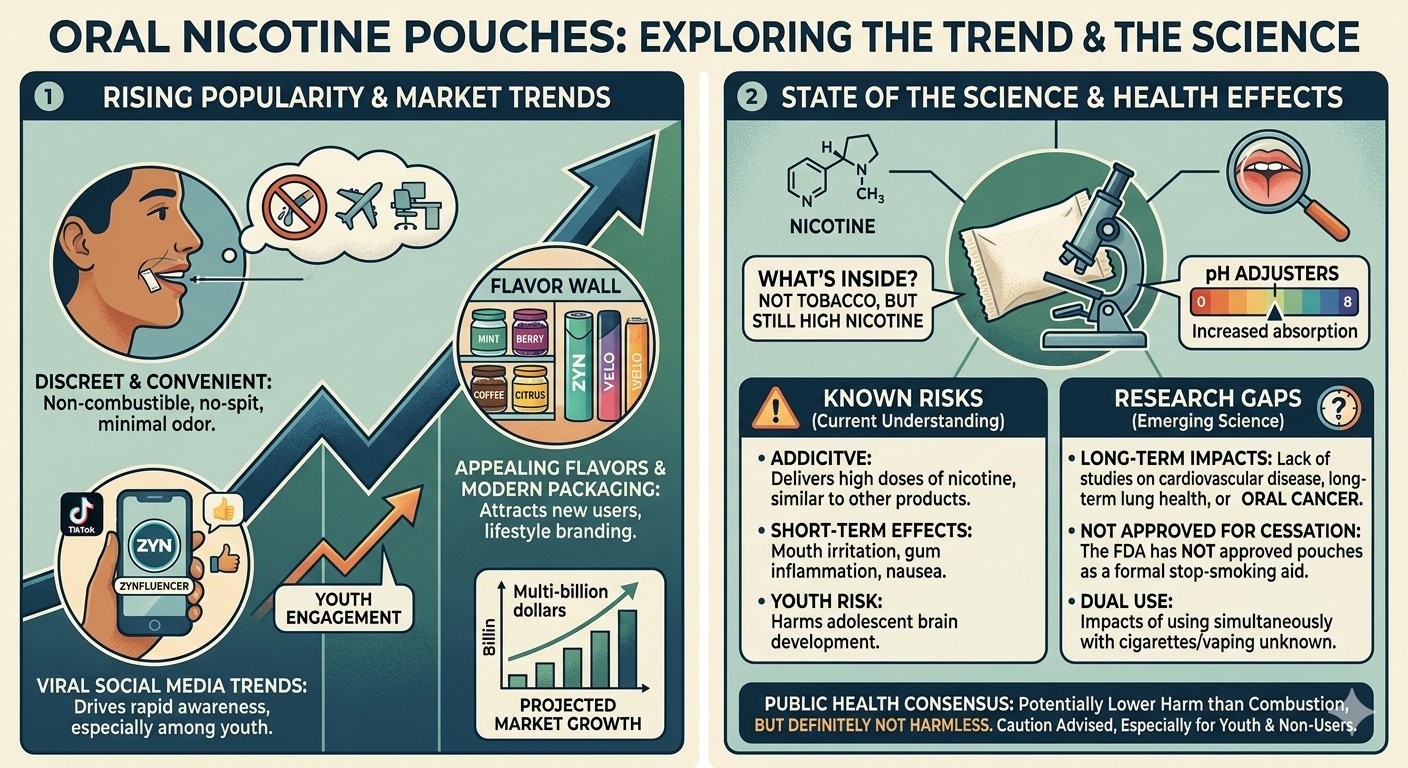
Nicotine pouches — rising popularity and the real state of the science
🔬 Public Health Reports · 2025·⏱ 10 min read·✍️ Diogo Oliveira Cordemans
✦ The essentials in 30 seconds
Nicotine pouches (ZYN, VELO, on!) are flooding pharmacies and social media. They contain no tobacco and aren't smoked — but they do deliver nicotine. Are they really less dangerous? Science says: probably, but we don't know everything yet. And nearly all the available studies were funded by the tobacco industry.
What exactly is a nicotine pouch?
Picture a small white pouch the size of a mint, tucked under the lip. No smoke, no vapor, no spitting. It contains nicotine — extracted from tobacco or synthetic — mixed with flavors, filling agents, and salts. The nicotine passes directly through the oral mucosa into the bloodstream.
The best-known brands are ZYN (Swedish Match), VELO (British American Tobacco), and on! (Altria). They're sold at concentrations ranging from 2 mg to over 8 mg of nicotine, in dozens of flavors — mint, fruit, cinnamon, coffee. It's precisely designed to appeal.
In the US, the FDA regulates them as tobacco products — even without any tobacco leaf — because they contain nicotine. No pouch has yet received authorization as a medical smoking-cessation aid.
Why is it exploding in popularity — especially among young people?
In the US, oral nicotine products have become the second-most used nicotine product among teenagers, just behind e-cigarettes. Between 2019 and 2021, their use among teens rose from 3.5% to 4.1%. And among young adults, up to 29% may be willing to try them.
Why? Complete discretion (no smell, no smoke), convenience (usable anywhere), polished marketing, and above all the perception that they're "tobacco-free so less dangerous." A shortcut that science strongly qualifies.
Less dangerous than a cigarette — really?
That's the central question. Short answer: probably, yes. No combustion, no tar inhalation. Studies show much lower levels of nitrosamines (the main tobacco carcinogens) compared to cigarettes. Inflammation and cardiovascular-exposure biomarkers were reduced by 22 to 97% in pouch users vs. smokers.
⚠️ But watch out
→Nicotine remains addictive, whatever the format
→In adolescents, nicotine disrupts brain development
→Cases of oral lesions, sore throat, and mouth ulcers have been reported
→The long-term effects are simply unknown
The problem with the available studies
Here's where the trouble lies. Nearly all the studies on the pharmacology and health effects of nicotine pouches were funded by the manufacturers themselves — Swedish Match, British American Tobacco, Altria. The authors of this scientific review make this explicit: these results must be verified by independent studies before drawing firm conclusions.
It's not that these studies are wrong — but the potential conflict of interest is real, and science requires independent replication.
🔍 Key takeaways
→Nicotine pouches contain no tobacco, but they do contain addictive nicotine
→Their popularity is rising, especially among teenagers and young adults
→Probably less toxic than cigarettes — but long-term effects remain unknown
→Nearly all available studies are funded by the tobacco industry
✦ Bottom line
Less dangerous doesn't mean safe.
Nicotine pouches may be a useful harm-reduction tool for some smokers. But between that and promoting them without reservation to non-smokers or teenagers, there's a chasm. Science is still catching up with the market — and that's precisely where the problem lies. The products are already everywhere. The independent data is not.
✦ Free newsletter
Want the next article straight to your inbox?
Free · Zero spam · Next article drops this week.
✦ Intermediate summary
Oral nicotine pouches deliver nicotine doses comparable to cigarettes and chewing tobacco, but more slowly. Toxicological profiles are substantially lower than those of cigarettes. However, their smoking-reduction potential remains uncertain, their impact on non-smokers is concerning, and most available data comes from industry-funded studies.
Composition and physicochemical characteristics
Nicotine pouches contain either tobacco-derived nicotine (ZYN, VELO, on!) or synthetic nicotine (FRĒ, FR3SH, NIC-S). Most use the nicotine salt form (bitartrate dihydrate), which modulates absorption. Total nicotine content ranges from 1.3 to over 47 mg per pouch depending on brand and strength.
A key parameter is pH: of 44 brands analyzed, 43 have an alkaline pH (median: 8.8). This elevated pH favors the free-base form of nicotine, which is more lipophilic and therefore more easily absorbed by the oral mucosa. Free-nicotine content ranges from 7.7 to 99.2% across products — considerable heterogeneity with real pharmacological implications.
Pharmacokinetics: how much nicotine, and how fast?
Pharmacokinetic studies show that nicotine pouches deliver plasma concentrations similar to those of cigarettes, but with a peak (Cmax) reached much more slowly. Time to nicotine peak (Tmax) is 22 to 65 minutes for pouches, versus 7 to 8 minutes for a cigarette. This slower kinetic profile is associated with probably lower addictive potential — peak speed contributes to the reward effect.
Product
Cmax (ng/mL)
Tmax (min)
Comparison
on! pouch 4 mg
~12
~33
Close to cigarette
Cigarette (usual brand)
~17
~8
Reference
ZYN 8 mg
~18,5
~60
Similar to snus
NRT gum 4 mg
~4,4
~48
Lower than pouch
Toxicological profile: substantially better than a cigarette, but not neutral
Industry studies show that levels of tobacco-specific nitrosamines (NNN, NNK), polycyclic aromatic hydrocarbons, and other toxicants are very low in pouches — 22 of 25 tested were non-quantifiable, compared to only 11 for snus. This profile is comparable to FDA-approved NRTs.
However, pouches contain synthetic cooling agents (such as WS-3 in ZYN menthol varieties) and traces of formaldehyde, chromium, and nickel — whose long-term effects during daily oral use are uncharacterized.
Do pouches help people quit smoking?
The data is promising but insufficient. In a 6-week industry-funded trial, 82% of smokers reduced their consumption with VELO pouches — but only 3% quit completely. In another on! trial, 27% of smokers had fully switched to pouches after 6 weeks. These numbers are encouraging, but these studies have significant methodological limitations and weren't compared to FDA-approved cessation methods (varenicline, NRT).
🔍 Key points
→Nicotine delivery similar to a cigarette, but slower kinetics (Tmax 22–65 vs 7–8 min)
→Toxicological profile substantially lower than cigarettes, comparable to NRTs on some markers
→Smoking-reduction potential: positive preliminary results, but all studies industry-funded
→Real risk of nicotine initiation in non-smokers, particularly teenagers and young adults
✦ What it changes in practice
The tobacco harm-reduction debate can't ignore nicotine pouches — but it can't trust them without independent data either.
If independent data confirms pouch efficacy for cessation, their population-level benefit will have to be weighed against their appeal to non-smokers and teenagers. That's exactly the standard the FDA uses to evaluate new tobacco products: the benefit for those quitting must outweigh the initiation risk for those not yet using.
✦ Extended abstract
Felicione et al. (2025) present a narrative review of the literature on nicotine pouches (NPs). Their analysis covers physicochemical characterization, pharmacokinetic data, biomarkers of exposure and potential harm, behavioral smoking-reduction studies, marketing strategies, and consumer perceptions. Central conclusion: the field is severely lacking in independent studies, and current data does not allow definitive judgment on the population-level impact of NPs.
Physicochemistry and nicotine delivery: remarkable heterogeneity
Analysis of 44 brands reveals extreme variance: pH from 6.86 to 10.1, total nicotine content from 1.29 to 6.11 mg/pouch in some analyses, and from 1.8 to 47.5 mg in industry studies. Free nicotine (unprotonated base form) ranges from 0.17 to 6.07 mg/pouch, with a free fraction of 7.7 to 99.2%. This variability has direct clinical implications: transmucosal absorption depends on the free-base fraction (nicotine pKa ≈ 8.02; at alkaline pH, free-base fraction increases per Henderson-Hasselbalch).
Some pouches (2 of 44 tested) reach levels above 40 mg/pouch — a level that raises legitimate questions of acute toxicity, particularly in cases of accidental pediatric ingestion.
Comparative pharmacokinetics: industry study data
The available PK studies (all industry-funded, N = 6 studies) compare NPs to cigarettes, snus, smokeless tobacco, and NRTs. Highlights:
→Cmax: variable by brand and dose (8.5–18.4 ng/mL for 4–10 mg). Nordic Spirit 9 mg (Cmax 18.4) and Lyft 10 mg (17.1) exceed ZYN 10 mg (11.0), suggesting a major role for formulation beyond nominal dose.
→Tmax: 22–65 min for NPs vs. 7–8 min for cigarettes. This lag reduces immediate positive reinforcement, a key parameter of abuse potential per pharmacological dependence models.
→NRT comparison: NP Cmax (8.5 ng/mL for 4 mg) is comparable to the NRT lozenge (8.3 ng/mL) but higher than NRT gum (4.4 ng/mL). An ad libitum study (4h) on NPs at varying concentrations documents inverse dose-consumption: 18 pouches/4h for 1.5 mg vs. 6 pouches/4h for 8 mg — consistent with compensatory titration.
Biomarkers of exposure and potential harm
An industry study (VELO vs. smokers) reports reductions of 22.7 to 97.2% in biomarkers including NNAL (NNK metabolite), NNN, sICAM-1 (inflammation), carboxyhemoglobin, and six exposure biomarkers (3-HPMA, 3-OH-B[a]P, HMPMA, MHBMA, S-PMA, NNN). Several biomarkers (including 8-Epi-PGF2α, an oxidative stress marker) remained similar between NPs and smokers — a signal for vigilance.
A randomized controlled trial (on!, 7 days) shows that exposure biomarkers in smokers switching to NPs approach those of subjects who quit completely — an impressive result, but over 7 days only, in an industry context.
On the oral level: reduction of pre-existing mucosal lesions in snus users switching to NPs (6 weeks), and reduced in vitro pro-inflammatory cytokine production by mononuclear cells exposed to NPs vs. snus. Against that: a cross-sectional survey documents oral adverse events in 25% of current users (ulcers, pain, irritation).
Marketing strategies and regulatory issues
Marketing analysis reveals deliberately targeted strategies: ads predominantly feature white men; VELO dominated ad spending through 2022 (representing nearly 90% of oral nicotine spending) before dropping to zero after the FDA's regulatory authority expanded to non-tobacco nicotine products in April 2022. ZYN has since taken over with the slogan "flavor-ban approved" — messaging that explicitly exploits regulatory restrictions as a selling point.
No manufacturer has yet received an FDA marketing order for its pouches, and none has authorization as a cessation aid (CDER). Lucy markets its products as "PMTA accepted" — implying an authorization that doesn't yet exist. This type of misleading communication illustrates the current regulatory vacuum.
🔬 Limitations & outlook
→Funding bias: all available PK and biomarker studies are industry-funded — independent replication absolutely necessary
→Observation duration: no independent longitudinal study on long-term effects under real-world use conditions
→Product heterogeneity: results are brand-specific and cannot be generalized to the whole market
→FDA standard: to meet the "appropriate for the protection of public health" threshold, NPs will need to demonstrate that benefits to current smokers outweigh initiation risk in non-smokers — an unsolved equation
✦ Critical reading
An honest review of a field dominated by industry — and that's precisely what makes it valuable.
Felicione et al. take no firm stance, and that's the right approach in the current state of knowledge. The strength of this work is its rigorous mapping of what we know, what we don't, and its explicit identification of gaps — notably the near-total absence of independent studies on meaningful clinical outcomes. Harm-reduction potential exists theoretically; the data to confirm it in real-world practice is not there. This scientific vacuum, combined with an industry de facto self-regulating while awaiting oversight, represents a real public-health risk — particularly for the adolescents these products reach with formidable marketing efficiency.
Primary source
Felicione NJ, Ozga JE, Eversole A, et al. Oral Nicotine Pouches: Rising Popularity and State of the Science. Public Health Reports. 2025. doi:10.1177/00333549251313668. Funded by the National Institute of Drug Abuse and the FDA Center for Tobacco Products (U54DA046060).
Key references cited in this review
[1]Rensch J, et al. Nicotine pharmacokinetics and subjective response among adult smokers using different flavors of on!® nicotine pouches compared to combustible cigarettes. Psychopharmacology. 2021;238(11):3325–3334. doi:10.1007/s00213-021-05948-y
[2]Liu J, et al. Nicotine pharmacokinetics and subjective responses after using nicotine pouches with different nicotine levels compared to combustible cigarettes and moist smokeless tobacco. Psychopharmacology. 2022;239(9):2863–2873. doi:10.1007/s00213-022-06172-y
[3]McEwan M, et al. A randomised study to investigate the nicotine pharmacokinetics of oral nicotine pouches and a combustible cigarette. Eur J Drug Metab Pharmacokinet. 2022;47(2):211–221. doi:10.1007/s13318-021-00742-9
[4]Lunell E, et al. Pharmacokinetic comparison of a novel non-tobacco-based nicotine pouch (ZYN) with conventional, tobacco-based Swedish snus and American moist snuff. Nicotine Tob Res. 2020;22(10):1757–1763. doi:10.1093/ntr/ntaa068
[5]Azzopardi D, et al. A randomised study to assess the nicotine pharmacokinetics of an oral nicotine pouch and two nicotine replacement therapy products. Sci Rep. 2022;12(1):6949. doi:10.1038/s41598-022-10544-x
[6]McEwan M, et al. Plasma nicotine pharmacokinetics of oral nicotine pouches across varying flavours and nicotine content. Contrib Tob Nicotine Res. 2023;32(4):130–139. doi:10.2478/cttr-2023-0016
[7]Azzopardi D, et al. Assessment of biomarkers of exposure and potential harm in exclusive users of nicotine pouches and current, former and never smokers. Biomarkers. 2023;28(1):118–129. doi:10.1080/1354750x.2022.2148747
[8]Rensch J, et al. A randomized, controlled study to assess changes in biomarkers of exposures among adults who smoke that switch to oral nicotine pouch products. J Clin Pharmacol. 2023;63(10):1108–1118. doi:10.1002/jcph.2293
[9]Stanfill S, et al. Characterization of total and unprotonated (free) nicotine content of nicotine pouch products. Nicotine Tob Res. 2021;23(9):1590–1596. doi:10.1093/ntr/ntab030
[10]Mallock N, et al. Levels of nicotine and tobacco-specific nitrosamines in oral nicotine pouches. Tob Control. 2024;33(2):193–199. doi:10.1136/tc-2022-057280
[11]Duan Z, et al. Nicotine pouch marketing strategies in the USA: an analysis of ZYN, on! and Velo. Tob Control. 2024;33(2):154–163. doi:10.1136/tc-2022-057360
[12]Schneller LM, et al. Tobacco-free oral nicotine product use among youth in the U.S., 2019–2021. AJPM Focus. 2023;2(1):100061. doi:10.1016/j.focus.2022.100061
🍪 Ce site utilise Google Analytics et le Pixel Facebook pour mesurer son audience. Ces outils ne sont activés qu'avec votre consentement. Politique de confidentialité →